
Patio vs Decking: Which Is Best for Your Garden?
If you’re planning a new outdoor living space, one question comes up again and again: patio or decking? Both create a practical, attractive area for relaxing, dining and entertaining — but they differ on cost, maintenance, how they suit your garden and how long they last. This guide compares patios and decking honestly so you can decide which is the right choice for your home.
Quick answer: patio vs decking
A patio is a hard paved surface (porcelain, natural stone or concrete) that is extremely durable, low-maintenance and ideal for ground-level areas. Decking is a raised timber or composite platform that is excellent for sloping or uneven gardens and creates a warm, elevated feel. Patios generally last longer and need less upkeep, while decking is often better for awkward levels and a quicker transformation. The best choice depends on your garden’s layout, your budget and the look you want.
Key takeaways
- Patios are hard paving (porcelain/stone/concrete); decking is a raised timber or composite platform.
- Patios usually last longest and need the least maintenance, especially porcelain.
- Decking is the better solution for sloped, uneven or raised gardens.
- Composite decking closes the maintenance gap with patios but costs more upfront than timber.
- Groundwork and installation quality decide how long either option lasts.
What’s the difference between a patio and decking?
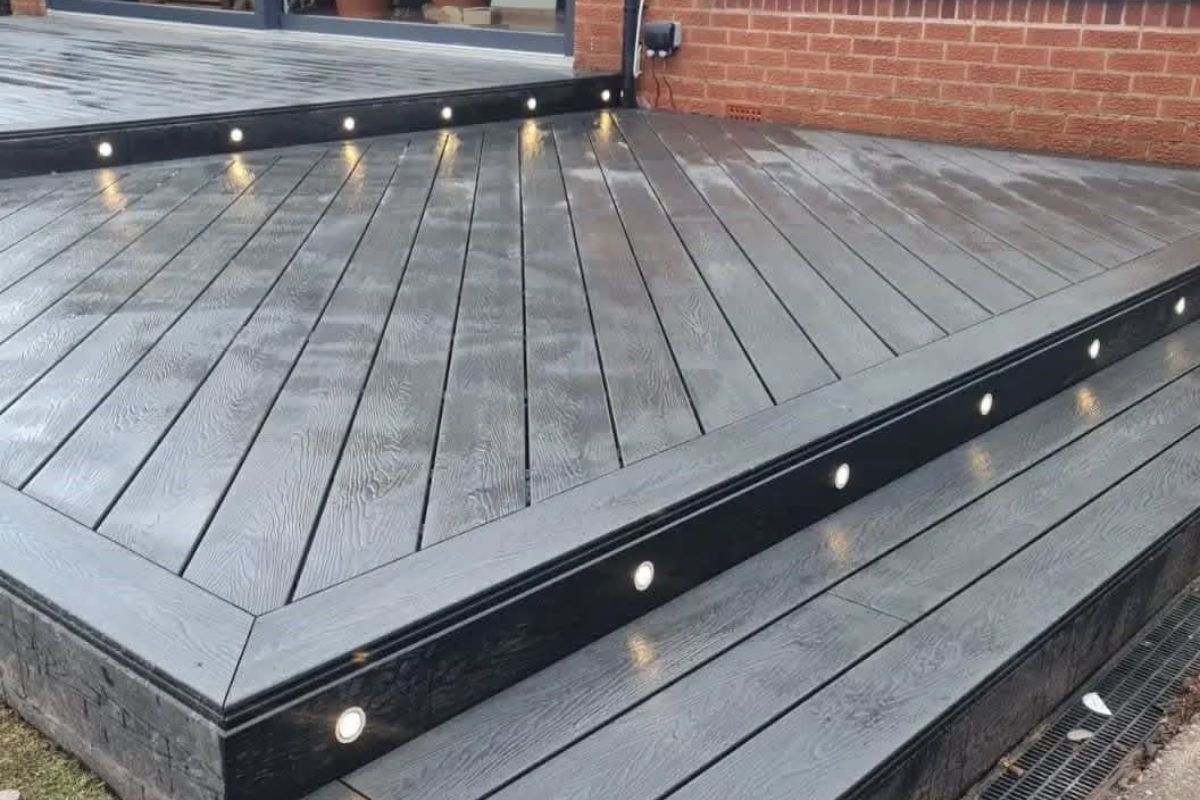
A patio is a solid paved surface laid onto a prepared base, using materials such as porcelain, natural stone or concrete. Decking is a platform built from timber or composite boards fixed to a supporting frame, which can sit at ground level or be raised to create a level area over a slope. In short, a patio is paved and grounded, while decking is built and can be elevated.
Patio vs decking: side-by-side comparison
| Factor | Patio | Decking |
|---|---|---|
| Material | Porcelain, stone, concrete | Timber or composite boards |
| Durability | Very high | High (composite) to moderate (timber) |
| Maintenance | Low (porcelain lowest) | Moderate (timber) to low (composite) |
| Lifespan | 20+ years | 15–25+ years (composite longer) |
| Best for | Ground-level areas | Sloped, uneven or raised gardens |
| Slip resistance | High with textured finish | Good; can be slippery when damp/mossy |
| Look & feel | Sleek, solid, modern or traditional | Warm, natural, elevated |
| Installation | Groundwork + paving | Frame + boards (often faster on slopes) |
| Heat underfoot | Can warm in sun | Stays cooler; timber comfortable |
How much does a patio cost vs decking?
Both patios and decking vary widely in price depending on the materials, the size of the area and the groundwork involved, so a site-specific quote is the only accurate figure. As a general guide, timber decking often has the lowest upfront cost, porcelain and natural stone patios sit at the higher end, and composite decking is typically comparable to a quality patio because the boards themselves are a premium product. Crucially, the largest share of the cost on either project is usually the preparation and installation — the base and groundwork for a patio, or the frame and footings for decking — not just the surface material. That’s why the cheapest quote rarely represents the best long-term value.
Patio pros and cons
Pros: extremely durable and long-lasting; very low maintenance (porcelain needs no sealing); excellent slip resistance with the right finish; suits both modern and traditional homes; adds lasting property value.
Cons: higher material and installation cost for premium paving; best suited to level ground, as sloped sites need extra groundwork; a bigger initial project than laying decking over a frame.
Decking pros and cons
Pros: ideal for sloping, uneven or raised gardens where a patio would need major groundwork; creates a warm, natural, elevated outdoor room; composite options are low-maintenance and long-lasting; can be a faster transformation on difficult sites.
Cons: timber needs regular cleaning and treatment; boards can become slippery if algae builds up; composite decking costs more upfront than timber; a quality frame and footings are essential for safety and longevity.
Which should you choose for your garden?
Choose a patio if your garden is reasonably level, you want the longest-lasting, lowest-maintenance surface, and you like a solid, paved finish — porcelain in particular is hard to beat for durability and easy care. Choose decking if your garden slopes or sits at an awkward level, you want to create a raised seating area, or you prefer the warm, natural feel of timber or composite boards. Many of the best gardens use both — a paved patio for the main dining area and raised decking to handle a change in level — which a full garden design service can plan as one cohesive space.
Can you combine a patio and decking?
Yes — combining the two is one of the most effective ways to use a garden, especially where the ground changes level. A patio can form the main entertaining area near the house, with decking used to create a raised platform, a seating zone or a transition across a slope. Designed together, the two materials complement each other and make the whole garden more usable.
Planning a patio or decking project in Lincoln?
At Bespoke Landscaping, we design and install both patios and decking across Lincoln and Lincolnshire, with expert groundwork and a 5-year installation guarantee. Whether you want a sleek porcelain patio, a warm composite deck, or a combination of both, our team will help you make the most of your space. Contact us for a free, no-obligation quote to discuss your project.
Frequently asked questions
Is decking cheaper than a patio?
Timber decking is often cheaper to install than a premium patio, while composite decking is usually comparable to a quality patio. Because groundwork and installation make up most of the cost on either option, the overall difference is often smaller than the surface price suggests.
Does a patio or decking last longer?
A patio generally lasts longer, with porcelain and natural stone surfaces lasting 20 years or more and needing little upkeep. Composite decking can last 25 years or more, while timber decking lasts well with regular maintenance. Installation quality is the biggest factor for both.
Is decking or a patio better for a sloped garden?
Decking is usually the better choice for a sloped or uneven garden because a raised, level platform can be built over the slope. A patio on sloping ground needs significant groundwork and levelling, which can add to the cost and time.
Which needs less maintenance, a patio or decking?
A porcelain patio needs the least maintenance of all — just an occasional wash, with no sealing required. Composite decking is also low-maintenance, while timber decking and some natural stone need periodic cleaning and treatment to stay at their best.
Can you put decking over an existing patio?
In many cases decking can be built over an existing patio, provided the surface is sound and drainage and heights are handled correctly. It’s best to have an installer assess the area first to make sure the structure and levels will work safely.